Hello everyone,
thank you for your continued interest in my little project, even if I haven’t updated in a while. The Pandemic, while so far having spared family and friends, keeps my busy with school closings and home office, cooking and organizing. So although Ken has faithfully plodded on with his monumental “Scorched Earth” report, I haven’t managed to put any of his postings online yet. All the more new reading to be expected after the summer break!
I already called the anniversary last December, but found the time to go through my old stuff recently. It seems that this domain went online on July 15th, 2000, which means the Generalstab today officially celebrates its 20th birthday! Yay to the Europa-Community, and thank you all again for your continued interest, support, articles, comments and game reports. I cannot possibly name everyone that made this site possible – as I said often enough YOU wrote all those pages, I merely collected them and make them look pretty. So three cheers for Europa, and now back to the dugout, waiting for “Total War”.
P.S: I Hope it is in everyones interest that I won’t illustrate this post with any German soldiers celebrating.
Twenty years since the first iteration of this website went online.
Ten years since “Total War” was supposed to be published.
Currently online: March ’43 in a game that is slowly reaching epic proportions: The “Scorched Earth”-report by Ken Newall. Red the new turn reports here.
Happy New Year, everyone!
After the conclusion of this years staff rides to the battlefields of Bennigton, Fort Henry and Prospect Park, we now return to our regular schedule with news from Ken Newalls Scorched Earth game. Three turn reports in a row means we’re approaching the end of 1942, and the chickens have finally come home to roost for the Axis, with the 11th Army being in grave danger of being encircled around Velikiye Luki by a resurgent Red Army.
After this, we will take a break to recuperate from our excursions and march off some of the excess baggage we collected as a result of the excellent food found in New England.
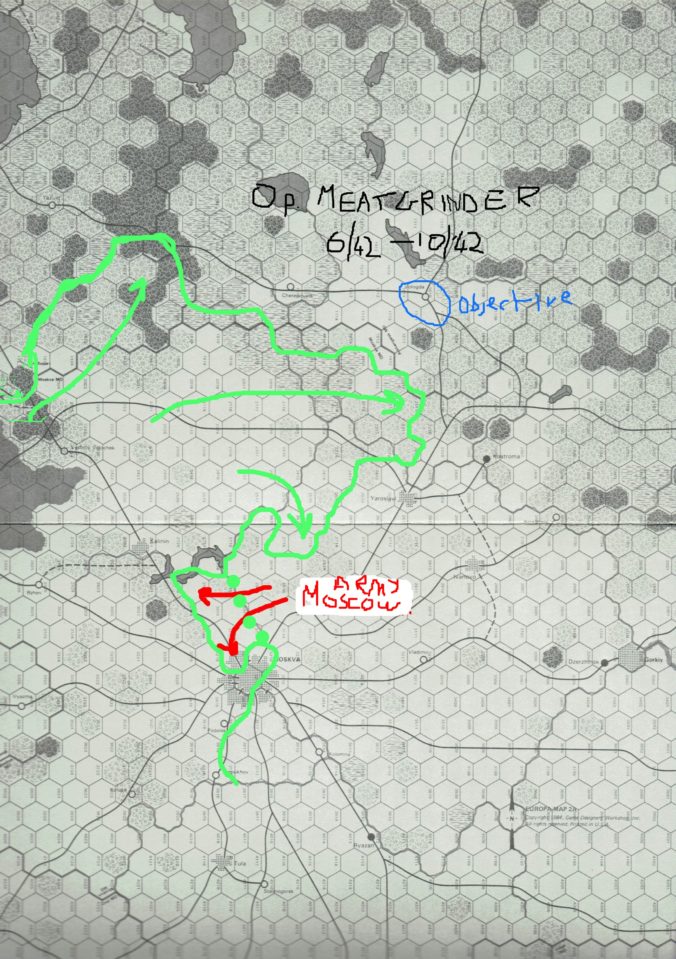
Bleak Years
After two years and uncountable losses and destruction, neither side can claim victory in the East.
The Axis still flies the swastika from the towers of the Kremlin, and their spearheads repeatedly cut the last rail line to Leningrad in summer. In the South, the Germans repeated last years successes on a smaller scale, repeatedly encircling and crushing large Soviet Armies. 6th Army finally captured Rostov, the gate to the Caucaus, after a swirling, gruesome campaign across the vast plains between Dnjepr and Don that lasted the better part of the year.
However, the Axis failed to reach its declared campaign goal of cutting of Leningrad, Russias second largest city, starving it to death and thus securing its Finish ally. In frozen Karelia, the Finns are fighting a desperate rearguard action, their divisions reduced to regiments, regiments to bataillions, the army ruined along with the burning wrecks of 19th Panzer XX sent to stop the Soviets. During Autumn, the Soviets pried the Panzers from the last open rail line before the German infantry could close up, reestablished supply and secured the continued flow of reinforcements to the cradle of the revolution. Now, its winter, and the Soviets grow stronger: The new tank corps armed with the T-34 rolling of the assembly lines in the Urals that now are back into production managed for the first time to take on a German Panzerkorps head on and force a retreat. The Germans frantically equip their famed Panzer divisions with newer and better tanks, but there are never enough of them around.
The parade to commemorate the October Revolution is a grim specacle this year. In Kubychev, a small crowd is commanded to watch the parade, its listless cheers saluting regiments that will be committed to battle barely two days later. However, the German soldiers guarding Moscow’s Red Sqare can already hear the rumble of tanks and artillery as the First Guards Tank Army advances through the eastern and northern suburbs, poised on liberating the capital.
Despite the exhaustion, neither side seems yet approaching collapse.
Ken Newall takes a look at his truly epic Scorced Earth report after two years of campaining: 1942 Game Commentary
The Axis Allies in Barbarossa
The last essays from Jason Long’s defunct website “Panzerkeil” have now been published in the Academy, with the kind permission of the author:
The Axis Allies on the Eastern Front
In Memoriam Panzerkeil
Jason Long is a household name to many Europa players. Jason did a lot of historical research centered on the war in the East and the Balkans and published numerous articles in TEM and various Newsletters. He also created several Europa scenarios (“Clash of Titans”) and designed the unpublished Peace in Our Time game on the invasion that almost occurred, the planned German assault on Czechoslovakia in 1938.
For a long time, Jason ran two websites dedicated to the Axis air forces (Sturmvogel) and Axis armies (Panzerkeil). Both are offline or archived now, but Jason kindly gave permission to us to re-publish some of his materials. Since “Total War” will most likely never see the light of day, we’ve decided to include some of Jasons research on the Hungarian Army during Barbarossa, which you can now read in the Academy. In the comming weeks, we’ll add some more material.
Our first “Fall of France” game report has arrived, belatedly in two ways, first because the game is now quite old, and second because the game was played in 2012. However, we think it will make for a nice addition to the War Archive, and its author, Mike Willner, has allowed us to publish it here. Mike is from the “Metropolitan Wargamers” from Park Slope. I could share some fond memories of my visits to Park Slope and Brooklyn in summer, but I will offer something much more interesting instead and encourage you to have a look at their website & associated Yahoo Group: www.nycwargames.com.
Oh, and the game report? Here you go: Fall of France – Game Report No 1.
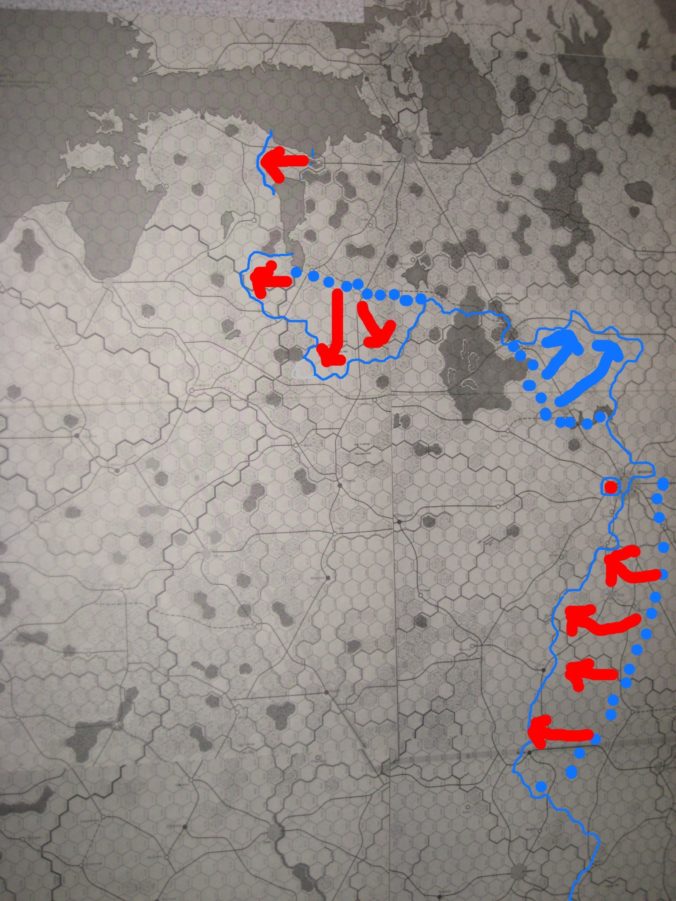
After Barbarossa – The status of Ken Newalls Scorched Earth game
Those of you following us on Twitter or are members of the Yahoo Europa Group will have recieved the biweekly updates to Ken Newalls ongoing game of Scorched Earth. All others hopefully will have taken a look at the expanding game report in the Archive now and then. For those who missed it, here’s a short summary: The game has reached May 1942, with the Axis having occupied Murmansk, the Baltics, and successfully conquered most of Moscow. The Soviets still hold out in the ruins of the eastern part of the city, and have successfully pushed from Leningrad to Narva and into the gap between lake peipus and the Valdai hills.
Now both sides evaluating their strategies for the upcoming summer, and since so many games of FiTE have ended at this point, Kens writings on the matter make for a facinating read we can only recommend. You can read the Soviet side here, and the Axis deliberations are part of the May I turn report.
Dan Waldstein graciously shared his report of a full game of FWtBT using a variable beginning of the revolution. The biggest upset during the start of the game was that Valencia also declared for the insurgency, and the Spanish Republic never recovered from that. In September 1937, all was over. How it happened, you can read here. We say thank you, and hope you’ll enjoy the read!
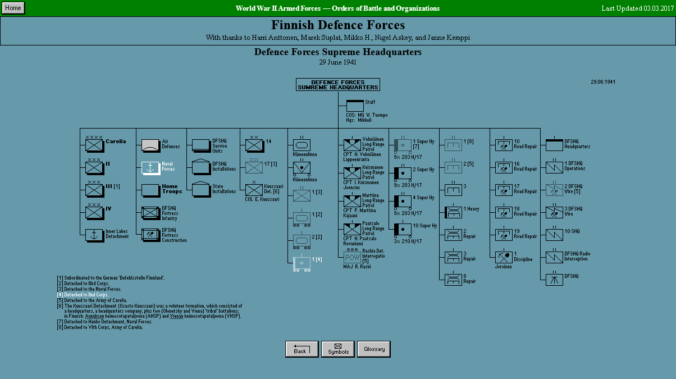
World War II Armed Forces – niehorster.org
Dr. Niehorster’s website on the Armed Forces of World War II needs little introduction I presume, being around even longer than the Generalstab and having itself established as one of the most important sites on TO/Es on the web. His thorough research has been the base for countless wargames, and his books are an established reference for scholars interested in the organisational details of armed forces in the Second World War. His Website provides extensive information about all participants at various stagtes of the war, while his books provide the background to the snapshots shown online.
As additional goodies, since Sept 12th the complete German WWII Organizational Book Series are now available for free as pdfs from its site. I can only strongly reccomend stopping by and grabbing a copy.
Date: Oct 15th, 2018
URL.: niehorster.org
We’re grateful for being able to provide you with yet another War in the Desert game report. This one was played and written up in the summer of 2018 by Bill Jenman. Since the game was mainly played to test some modifications of the Malta status number, the second half of the game report, from March 1942 onward, is summarized, nevertheless it makes for a good read. You can find it as WitD AAR No 3 in the archive, as always.
David Tinny was so kind as to provide a short game report of a WitD/GE test game he played this spring. Since the turn reports were sparse, I made a page for each year instead of each turn or month. Sadly enough, the website refused to show me the pages, throwing a 404 like a six-year-old looking for the third pair of gloves he was sent to school in. After neither my first strategy (googling the problem and implementing various fixes I have no idea how they are supposed to work) nor my second (ignoring and hoping it fixes itself by the way of a stray update) worked, I had to sit down and rattle a couple of loose things under the hood around. Y’know, like slapping a remote. And lo behold:
If you give a post a slug only made up from numbers, WordPress throws a hissy fit.
Of course, that applies to my wordpress, with my unique combination of various third-party plugins and my customized permalink settings. Apply at your own risk.
A slug, by the way, is the part of the URL that references the actual page, i.e. if your web-page named “Testing some stuff” had the URL “www.example.com/mysite/test” the slug for the page would be “test”). Why WordPress refuses to find the page …/ge-43-02/1940/ or …/ge-43-02/1940y/, but is perfectly happy to deliver at blazing speed a page under the adress of …/ge-43-02/y1940/, I do not know. Gremlins maybe. Bitrot most likely. Lazy programming FWIW. But frankly, I spent too much time experimenting around to find this, I am not willing to spend more time to fix it.
But, you, brave souls following me on this quick detour through the intestines of an aging wordpress installation, your prize is said game report, now available for your enjoyment here. Have a nice weekend!
P.S.: Some marketing genius did not only come up with this garbage, but obviously found enough braindamaged product owners to force some programmer to implement code into this content management system that makes sure WordPress is always spelled with a capitalized “P” in the middle, irrespective of however its written by the editor:

A view from the backend editor: WordPress with a small “p”
People get paid for coming up with these kind of ideas, you know? There is a career in taking desicions away from users and proscribing them what they can write on their own website. Wordfilters next. Wouldn’t want to disturbe the monitarization of content, yo.
Yes, so far I’m happy with WordPress.
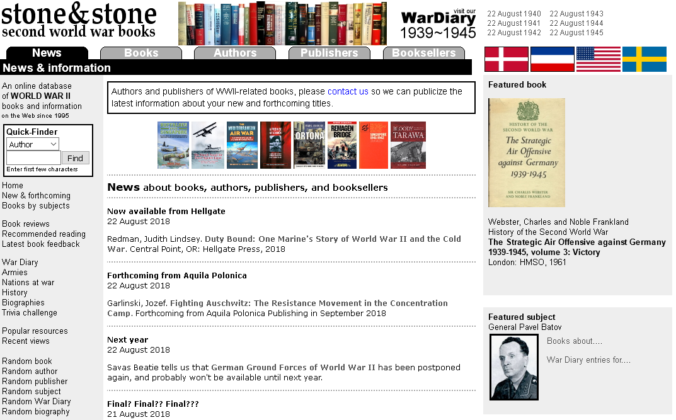
Stonebooks
Reading on anything to do with the Second World War is an intimidating task, since the literature is so vast that it seems impossible for any laymen to identify relevant books or simply those well enough written to deserve notice. Military history remains a topic of high interest, and serious studies often drown in the flood of available popular editions, autobiographies or “collections” of pictures, technical data or battle descriptions.
For those of us without access to a well-stacked library, stonebooks.com is an invaluable source, providing a structured catalogue of publications. Fleshed out with book reviews, a message board and and more catalogues of publishers and authors, stonebooks provides a great service for readers and historians alike.
Our hobby seems for most cases to be stuck in the early 00’s when it comes to design and usability, and stonebooks.com is no exception. However, we would ask our reader again for leniency: The website proves without a doubt one does not require Bootstrap to provide viewing pleasure. Additionally the author of the page, Bill Stone, is one of the oldest Europa veterans and former editor of E.T.O. Say Hi and grab a good book!
Date: August 22rd, 2018
URL: http://stonebooks.com
Iterum ante portas
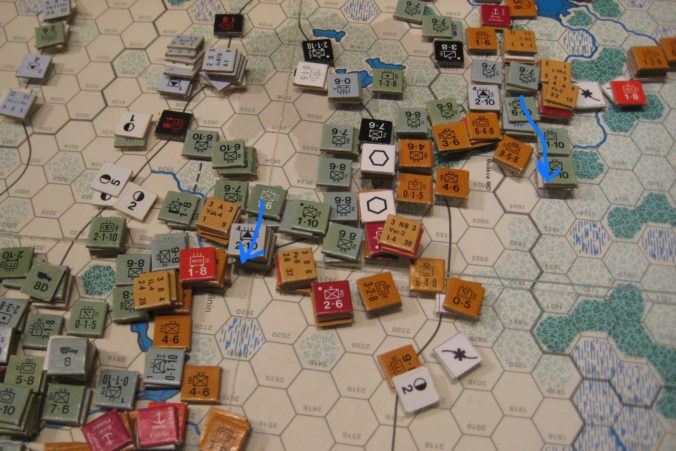
It is December 1941, (again). An unusually mild winter sees the Germans firmly in possession of Moscows suburbs after a gruelling campaign, while in the North forward detachments have finally reached the Murmansk railway line. Further south the Germans have occupied vast swathes of the Ukraine, though Odessa and Sevastopol still hold out against the fascist invaders…
In other words: we managed to upload Ken Newall’s new game report up to JAN I 1942, and it shows how helpful images are to understand the overall strategic situation – at least for a visual animal like me. Enjoy the read!
After completing the newsletter archive in the Generalstab Library some months ago there was still one issue missing: ETO #57. I have the basic TOC, but no authors, and was unable to find a copy of the newsletter anywhere. Since Arthur Goodwin was the editor at the time, I’ve contacted him directly, and will update if I recieve a reply.
We’re still being plagued by some technical problems, but in the making are two more game reports from War in the Desert, and it might be time for some more link additions soon.
Fire in the East/Scorched Earth truly defined the term “monster game” new when they came out. At more than 3.000 counters and maps large enough to cover a small basement floor, the game dwarved the competition. SE’s complexity and size also severly limited the number of games played, so we are very proud to be able to present our second game report of a FitE/SE game. The report of an ongoing game started in April 2018 is being written by Ken Newall, who again deserves our gratitude for allowing us to publish it here.
Since’ we’re currently experiencing some technical problems witrh the website, the menue isn’t done yet, but should follow in the next few days, along with more content.
Um, who am I kidding, It might be weeks. But we’re working on it.
Recent Comments