Europa Games and Military History

Category: Links (Page 1 of 5)

The Historiography of Australia’s Air Force

Today’s link recommendation is a blog post by Ross Mahoney tracing the inception of the official histories of the Australian Air Force, from the first volumes written about the Royal Australian Flying Corps in World War I to the present. These research notes are part of a larger bibliography of Australian Air Power which while out of the focus of this website, definitely deserves your attention.

The Historiography of Australian Air Power: Official Histories

US Army Field Manuals – A Collection

Full Disclosure: This is me advertising one of my own side projects
Over the years I’ve collected quite and amount of the publicly available US Field Manuals that set down doctrine and guidelines for the way the US Army trains, organizes, and operates. The collection is still woefully incomplete, but contains now ~1900 files of US Army Field manuals from 1930 to 2024. I hope it will be a useful resource for anyone interested in the US Army and its history.

URL:  https://sites.google.com/view/fieldmanuals/

VDV Manuals – A collection

Keeping it up with military manuals, in 2021 some friendly reseacher posted a huge cache of military manuals and publications from the academy of the Russian Airborne Forces, the Воздушно-десантные войска России (ВДВ), or VDV. Again a translation is necessary, which fortunately can be done for free with a range of tools online these days. But the files deserve their mention, especially since the site is virtually invisible on search engines these days, and not everone as the stomach to go Ex to view the sites Twitter account.

URL: http://russianairbornetroops.info

Ukrainian Field Manuals – A Collection

The Ukrainian people were forced into a brutal war by Russian dictator Vladimir Putin, and had to adapt quickly and creatively to stand against the numerical superiority of the Russian Army. Support from the West was often lackluster and unreliable, many NATO states themselves torn between rising nationalist sentiments,  pacifist traditions, and the desire to help a democratic European nation to defend itself.

The Training Department (G7) of the Headquarters of the Territorial Defense Forces Command of the Armed Forces of Ukraine follows the example of the US Army and has made most of its manuals available online to the public. With a bit of automated translations, a lot of knowledge about the Ukrainian Army is available in these documents.

As of this writing, the war is neither decided nor over, and we sincerely hope the West can find its way back and be a staunch defender of democracy and freedom.

URL: https://sprotyvg7.com.ua/vijskovi-publikacii


The Coastal Defense Study Group

Woe to the Europa player who ever would have to create maps for the US coast and put CD counters on them in any Europa scenario. Any game in which the Axis would be able to mount a significant threat to the US is one that has already turned sour for the Allies.
If you should find in such a predicament, though, the first and best source for such information would be the Coastal Defense Study Group and its exhaustive Wiki covering the history of US fortifications. The CDSG works to educate and preserve the history of the United States coastal defenses, and does so through conferences, a journal, and the already mentioned resources on the web.

URL: cdsg.org

The Official Italian History of the Second World War

The History Office of the General Staff of the Italian Army (Stato Maggiore dell’esercito – Ufficio Storico) is responsible for official military history, and thus has published a series of monographs, illustrating various aspects of military history from Italy’s unification to the present. Of course the Second World War makes up a significant part of the available volumes. No official, complete italian history of the Second World War was ever written, but it is well possible to piece together a nearly complete picture from the monographies at hand.

In the Nineties,  fifty years after the war, a series of volumes reflected on the North African campaign, and these four books are probably as close to an official history as we will ever get. The author, Mario Montanari, is a respected historian better known for his mor general work on the Italian “Risorgimento”, the national unification moevement that resulted in the foundation of an Italian nation state in 1849 from various independent fiefdoms that had endured since the collapse of the western Roman Empire.

Translations of large parts of the Italian official histories have been uploaded to archive.org and will be linked here. This is even more laudable as the original works do not seem to be available in digital form. The quality of the translation is questionable in parts, which adds another reason to take the contents of the books with a grain of salt (the other one, of course, being that its an official history). Then again, undertaking the translation of what to the rest of the world must be an obscure topic indeed is imminently a work of love, and we are deeply grateful to Robert Denny II.
Thanks to Jim Broshot for finding and sharing those links with us.

L’Esercito Italiano Nella Campagna die Greca

Mario Montanari, Rome 1999.
Translation by Robert Denny II: Italian Army Official History The Greek Campaign

Le Operazioni Della Unita Italiane Al Fronte Russo (1941-1943)

Rome 1977
Translation by Robert Denny II: Italian Army Offical History Operations On The Russian Front

Le Operazioni in Africa Settentrionale

Volume I: Sidi Barani – November 1940 – März 1941; by Mario Montanari, edited by Edizione Ufficio Storico SME, 1989; 720 pages, 29 maps.
Translation by Robert Denny II.

Volume II: Tobruk  – March 1941 – May 1942; by Mario Montanari, edited by Edizione Ufficio Storico SME, 1990;709 pages, 88 maps.
Translation by Rober Denny II

Volume III:  El Alamein – May – November 1942; by Mario Montanari, edited by Edizione Ufficio Storico SME, 1992; 1036 pages.
Translation by Rober Denny II.

Volume IV: Enfiddaville- November 1942 – March 1943. by Mario Montanari, edited by Edizione Ufficio Storico SME, 1993; 820 pages, 90 maps.
Translation by Robert Denny II

Le Operazioni in Siculia e in Calabria, Luglio – Settembre 1943

written by Alberto Santoni, published by Stato Maggiore Dell’Esercito – Ufficio Storico, Roma 1989.
Translation by Robert Denny II: Italian Army Offical History Operations In Sciliy & Cambera, 2017

La Marina Italiana Nella Seconda Guerra Mondiale

The contribution of the Italian navy has often been belittled, ignored or played down. One of the worlds strongest Navy, the Marina Militare suffered from similar problems as the Army and Air force, namely the call to fullfil ambitions which were way beyond the the industrial and technical capabilities of italy’s industry, and therefor its quipment and weaponry. The Navy did its best with the ressources available, but modernization was slow. Italy could not react to the revolutionary impact of the airplane, which was theorized early on and clearly recognized by its brightest thinkers, to their deep and lasting frustration.

Thanks to the work of Robert Denny II a complete translation of the official work is available on archive org. Errors in the numbering of the volumes have not been corrected yet.

La Regia Aeronautica 1939-1945

Written by Nino Arena, published by Stato Maggiore Aeronautica

Volume 1: 1939-1940: Dalle Non Belligeranza All’Intervento. Roma 1981

Translated by Robert Denny II as: The Royal Air Force. Volume 1: From Non Belligerence to Participation, 2021
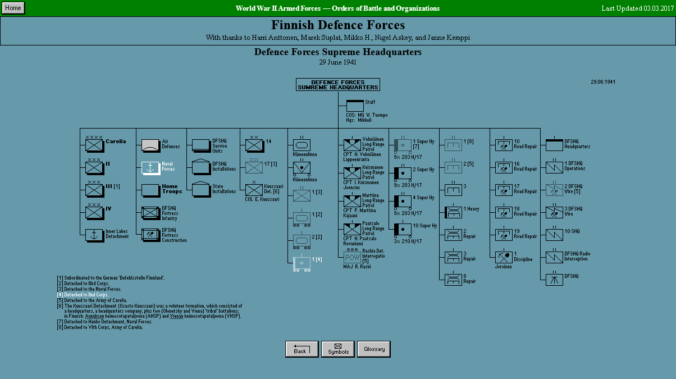
World War II Armed Forces – niehorster.org

Dr. Niehorster’s website on the Armed Forces of World War II needs little introduction I presume, being around even longer than the Generalstab and having itself established as one of the most important sites on TO/Es on the web. His thorough research has been the base for countless wargames, and his books are an established reference for scholars interested in the organisational details of armed forces in the Second World War. His Website provides extensive information about all participants at various stagtes of the war, while his books provide the background to the snapshots shown online.

As additional goodies, since Sept 12th the complete German WWII Organizational Book Series are now available for free as pdfs from its site. I can only strongly reccomend stopping by and grabbing a copy.

Date: Oct 15th, 2018
URL.: niehorster.org

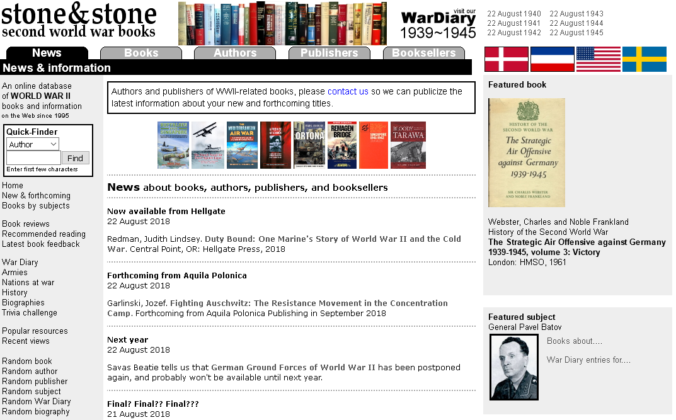
Stonebooks

Reading on anything to do with the Second World War is an intimidating task, since the literature is so vast that it seems impossible for any laymen to identify relevant books or simply those well enough written to deserve notice. Military history remains a topic of high interest, and serious studies often drown in the flood of available popular editions, autobiographies or “collections” of pictures, technical data or battle descriptions.

For those of us without access to a well-stacked library, stonebooks.com is an invaluable source, providing a structured catalogue of publications. Fleshed out with book reviews, a message board and and more catalogues of publishers and authors, stonebooks provides a great service for readers and historians alike.

Our hobby seems for most cases to be stuck in the early 00’s when it comes to design and usability, and stonebooks.com is no exception. However,  we would ask our reader again for leniency: The website proves without a doubt one does not require Bootstrap to provide viewing pleasure. Additionally the author of the page, Bill Stone, is one of the oldest Europa veterans and former editor of E.T.O.  Say Hi and grab a good book!

Date: August 22rd, 2018

URL: http://stonebooks.com


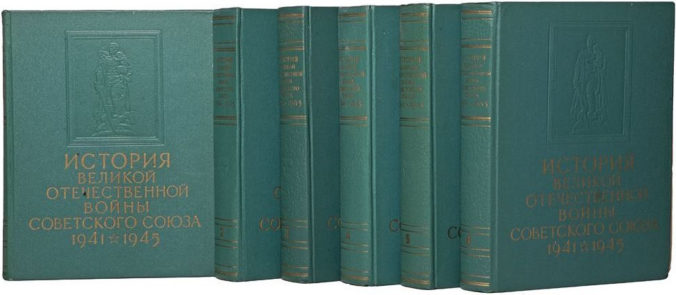
The official Soviet history of the Second World War

The first official history of the Second World War was published in the Soviet Union from 1960-64 and bore the title “История Великой Отечественной войны Советского Союза“ (History of the Great Patriotic War of the Soviet Union). The six volumes prepared by the editorial team around G. A. Deborin decribed the German attack on the USSR and the subsequent war until Germanys surrender in 1945. Although the work was translated in several languages, no English translation is available.

Contents:

Vol 1:  Подготовка и развязывание войны империалистическими державами. Events leading up to the war, the annexation of the baltic republics and the initial period of the Second World War (1 September 1939 until the invasion of the Soviet Union.

Vol 2:  Отражение советским народом вероломного нападения фашистской Германии на СССР. Создание условий для коренного перелома в войне (июнь 1941 г. — ноябрь 1942 г.) From the German invasion of the Soviet Union to the encirclement of the German Sixth Army at Stalingrad (22 June 1941 to November 1942)

Vol 3: Коренной перелом в ходе Великой Отечественной войны (ноябрь 1942 г.— декабрь 1943 г.) From The Battle of Stalingrad to the Battle of Kursk, (November 43 to August 1943)

Vol 4: Изгнание врага из пределов Советского Союза и начало освобождения народов Европы от фашистского ига (1944 год) From the Battle of Kursk to the liberation of Belorussia (August 1943 to July 1944)

Vol 5: Победоносное окончание войны с фашистской Германией. Поражение империалистической Японии (1945 г.)  From the liberation of Belorussia to the defeat of Germany (July 1944 to May 1945)

Vol 6: Итоги Великой Отечественной войны Cost and consequences of the Second World War.

The historiography of the Second World War in the former USSR is more complex due to censorship and the heavy political influence that went into any official description of events. Additionally, official viewpoints on historical events and persons were bound to occasionally sudden chances, depending on political developments.

A very useful description of the works genesis, its contents and public perception of the war in the USSR during the sixties can be taken from Yan Mann’s dissertation “Contested Memory: Writing the Great Patriotic War’s Official History During Khrushchev’s Thaw“, Dissertation, Arizona State University, 2016.


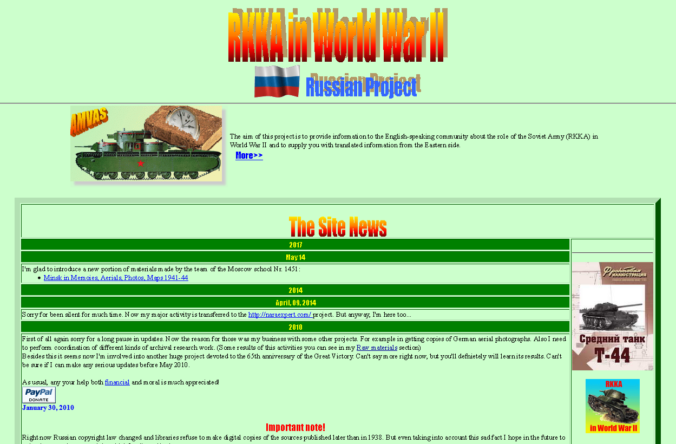
RKKA-WW2

Since 2003 RKKA provides a host of information on the Soviet Forces in World War Two: Formations, Force Structure, uniforms, Losses, Weapons and Maps. The Design hasn’t changed much since then, and the site hasn’t really been updated since 2010, so the website structure belies the sheer amount of information available, which definitly could use a more accessible navigation, and a lot of the maps and individual documents would profit from context.  But the amount of material presented makes RKKA one of the reference points for the Red Army in the Great Patriotic War. Since Alex, the site’s webmaster, is russian, many items are based on original research and russian sources.

Date: April 6th, 2018

URL: http://www.armchairgeneral.com/rkkaww2/


« Older posts